

 Dodaj wydarzenie
 Kalendarz
 Moje konto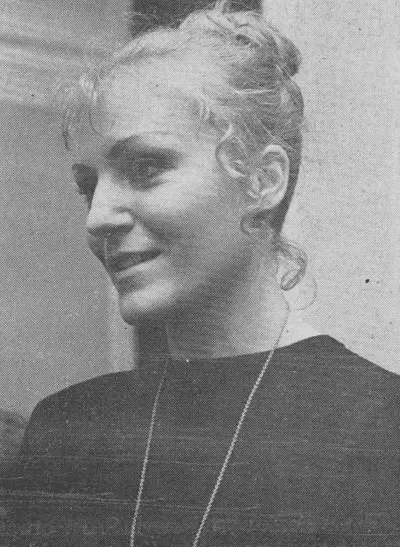


Anna German was an artist characterised by her extraordinary voice and charisma; her songs moved the hearts of thousands of listeners across the globe. Her life was full of lights and shadows – from major successes on the international stage to dramatic moments of struggling for her health. What did her rise to fame look like? What challenges did she have to overcome? This is the story of a woman whose music remains immortal.
Anna German – her history
Anna German was born on the 14th of February 1936 in Uzbekistan to a German father and Dutch mother. Anna German’s parents moved to Urgench, where she was ultimately born, due to the political events of the time. The family faced multiple difficulties; both Anna’s poor health since her childhood years and the political uncertainty of Uzbekistan filled their life with instability.
One of the most important and simultaneously the hardest events of Anna’s life was the arrest of her father, Eugen Hörmann, on charges of espionage. This detention ended tragically, as Eugen was executed. This dramatic development led Anna’s mother, Irma Berner, to leave Uzbekistan in order to ensure the safety of herself and her daughter. They lived for a while in consecutively Kyrgyzstan and Kazakhstan. After the Second World War Irma received the possibility of settling down in Poland on the grounds of her Polish heritage. And so was Poland enriched by one of the most talented artists in the history of music.
One of the most important and simultaneously the hardest events of Anna’s life was the arrest of her father, Eugen Hörmann, on charges of espionage. This detention ended tragically, as Eugen was executed. This dramatic development led Anna’s mother, Irma Berner, to leave Uzbekistan in order to ensure the safety of herself and her daughter. They lived for a while in consecutively Kyrgyzstan and Kazakhstan. After the Second World War Irma received the possibility of settling down in Poland on the grounds of her Polish heritage. And so was Poland enriched by one of the most talented artists in the history of music.
Anna German – Jedna chwila wystarczyła
Anna’s first contact with music in a more professional manner took place when she was a geology student at the University of Wrocław. Her already impressive singing skills were recognised and praised by Bogusław Litwiniec, who invited her to join the Kalambur Theatre, which he was running at the time. Anna’s first success came swift – her performance was good enough to land her the main prize at the first Nationwide Festiwal of Student Culture in Cracow.
Her collaboration with the Kalambur Theatre was not a one-time performance, however after a while Anna resigned, wanting to pursue her singing career in a different fashion. She tried multiple approaches, including taking part in Polish Radio Podwieczorek’s broadcast, singing at Zgaduj Zgadula concerts and working with Marek Sewen.
In 1962, aged 26, she tried her hand at singing at a larger stage for the very first time. She performed for two years in Estrada Wrocławska, touring across the whole country. Owing to her incredible talent, she was successful whether she worked in the radio, the theatre or onstage. Although she eventually parted ways with Estrada Wrocławska, Anna also worked with Estrada Rzeszowska. This cooperation led to a show in Warsaw which ultimately kickstarted her career and brought her recognition. She didn’t have to wait long for further successes, as in 1963 she won second place at the Polish competition of the 3rd International Song Festival in Sopot with the song Tak mi z tym źle (It Makes Me Feel So Bad). She also received the first prize at the 1st Nationwide Showband Festival in Olsztyn for her artistic interpretation of Ave Maria no Morro.
Anna German – Tańczące Eurydyki
The song Tańczące Eurydyki (Dancing Eurydices) was created in the 60s, when German was already a well-known artist, but lacked major international successes. This track proved to be a breakthrough in that regard, as it remains one of her most popular songs. Thanks to this song, Anna German won first place (on the Polish day), along with a Journalists’ Award at the 4th International Song Festival in Sopot in 1964. This was certainly one of the turning points of her career, as because of the song she finally began to gain recognition outside of Poland’s borders.
Anna German – Tańczące Eurydyki
Tańczące Eurydyki proved to be such a major success that in 1966 Anna released her debut album under the same name. Her astounding performance in Sopot, where she also won third place in the international competition led to her being acknowledged by prominent figures in the industry. She played many shows abroad, including but not limited to East Germany, Czechoslovakia, France, Portugal, England and the Soviet Union, winning one competition after another.
The singer didn’t just perform in Polish – many of her hits were composed in Russian. To this day many associate her strictly with this part of her oeuvre. The fact that Anna German was known for songs written in different languages serves as proof of her international stardom, which remains a rarity for artists.
The accident in Italy
In November of 1966 Anna German signed a three-year contract with an Italian record company. This allowed her to play shows in Italy and her songs to be broadcast on the national radio. She also took part in the 7th Sanremo Music Festival and therefore became the first Polish contestant in its history. Anna German was also the first foreigner to perform at the 15th Festival di Napoli and released an album in Italian sometime later.
The day of 28th of August, 1967 shocked the whole world of music. On the way back from one of her shows in Italy Anna was involved in a major car accident. The tragedy happened when Renato, her impresario, fell asleep behind the wheel, causing the left side of the car to hit a roadside wall. The impact was so powerful that German landed a dozen meters away from the scene. Renato was rushed to the hospital, however the paramedics were unaware of the famous singer’s presence in the vehicle. Badly wounded, Anna awaited help for the whole night.
Upon arriving at the hospital, her condition was assessed as critical. She had serious injuries, including a broken spine. Her medical treatment and rehabilitation went on for three years, which did not cause the artist to retreat from creative work, as in 1970 she released an autobiographical book titled Wróć do Sorrento? (Come Back to Sorrento?) and composed music to the poems of Alina Nowak.
Anna German – her career after the accident
After a long period of rehabilitation, on the 26th of December, 1969, Anna German returned to the stage with a performance on the Tele-Echo talk show. In 1970 she took part in a show titled Tobie, Warszawo (For You, Warsaw) and sang a series of 11 concerts in the Grand Theatre in Warsaw, receiving favourable reviews. The singer also released an album called Człowieczy los (Man’s Fate), which soon went gold. Her work was awarded at festivals in Opole and Sopot. Moreover, Anna German appeared in a documentary titled Powrót Eurydyki (The Return of Eurydice) and had an episodic role in Andrzej Wajda’s Krajobraz po bitwie (Landscape After the Battle).
In the following years Anna performed both in Poland and abroad, including the Soviet Union and the US among others. She received numerous awards, including the Warsaw Municipal Award. She was diagnosed with cancer in the mid-70s, but despite the illness continued to sing, for instance recording Echo miłości (The Echo of Love), featured in a Russian movie titled Sudba (Destiny). She also performed at the Song-77 Festival in Moscow and received a standing ovation.
Anna German – Człowieczy los
The last years of her musical career continued to be filled with international shows and successes. She performed in the US, Canada, the Soviet Union and Australia. After returning home from Australia her cancer, osteosarcoma, had recurred. The artist decided to suspend her career and unfortunately never came back. Anna German died in the evening of 25th of August, 1982, aged 46.
Anna German’s status remains forever immortalised in the history of Polish and international music. Her incredible talent, silky voice and unique artistic sensibility made her an icon of the music scene, adored by millions of listeners in Poland, the countries of the former Soviet Union, Italy and many other countries. Even though her life was full of hardship, from family tragedies and a serious accident to an ultimately lost battle against a deadly disease, she never lost her passion for music and the devotion to her audience.
Anna German – the greatest hits
- Tańczące Eurydyki
- Człowieczy los
- Być może
- Bal u Posejdona
- A kiedy deszcz
- Jedna chwila
Opisał: Paweł Skarzyński
Translate: Anna Maria Sokołowska
Zdjęcia: Wikipedia

Did you like our article? Check out other music news!
 Read also: Józef Skrzek – a multitalented musician. Do you know his songs?
Read also: Wanda i Banda – Hi-Fi beyond just the name. The band’s story
Read also: Fisz – his history. He’s in his element when he’s making music
Read also: Jimek – what connect Ranczo, Wisłocka and Sexify?
Read also: Antoni „Ziut” Gralak – the trumpeter who showed how to make jazz
Read also: Patricia Kazadi – someone who made the most of her chance to be successful